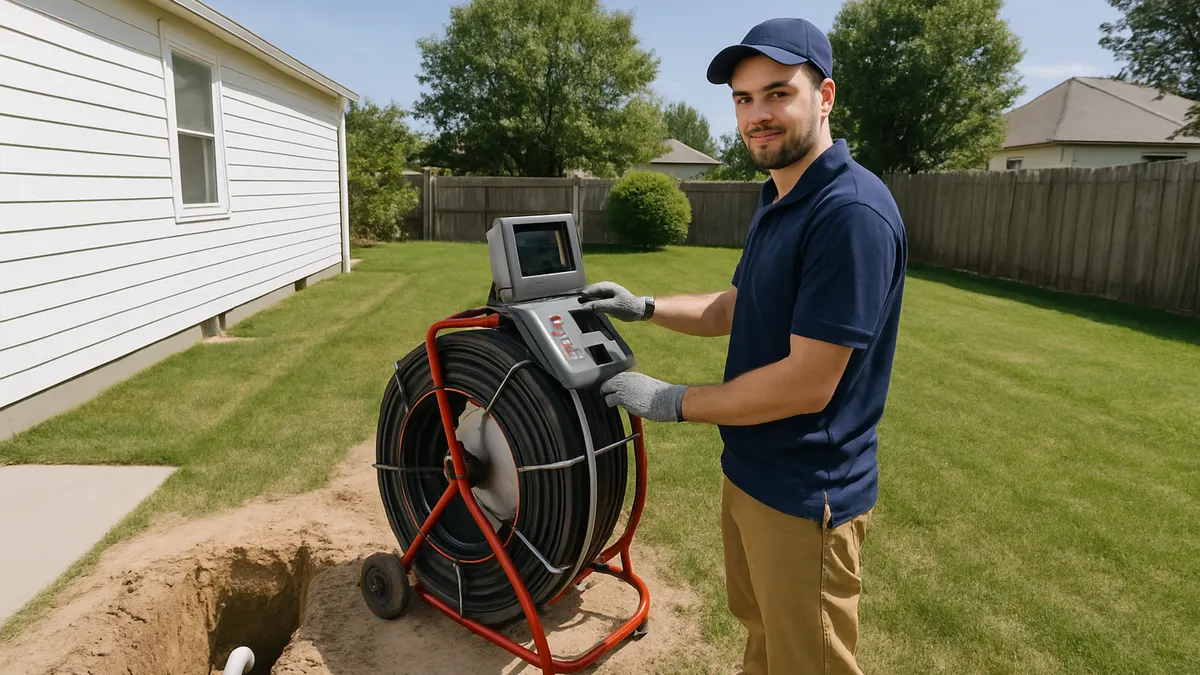
Trenchless sewer line repair restores a damaged underground pipe through one or two small access points instead of a long open trench. The two main methods are cured-in-place pipe (CIPP) lining, which forms a new pipe inside the existing one, and pipe bursting, which fractures the failing pipe outward while pulling a new pipe into its path. Most residential jobs finish in a single day, and your driveway, patio, and landscaping stay exactly where they are.
Few plumbing problems feel as intimidating as a failing sewer line. The pipe sits several feet underground, usually beneath a lawn or driveway, and for decades the only fix was to dig the whole length of it up — heavy equipment at the curb, a week of mud, and a bill that included re-sodding the yard and repouring concrete.
Trenchless technology changed that equation. A licensed plumber can now rehabilitate or replace most residential sewer laterals through two access pits no larger than a card table. Here is how the methods work, what they cost, and whether your home is a good candidate.
What Is Trenchless Sewer Line Repair?
Trenchless sewer line repair is a group of no-dig techniques for rehabilitating or replacing buried sewer pipe without excavating its full length. Rather than removing all the soil above the pipe, the plumber works through existing cleanouts or two small entry and exit pits, using the path of the old pipe as the route for the new one.
The approach came out of municipal utility work in the 1970s and has been standard on residential laterals for over twenty years. Plumbing codes across the United States recognize trenchless liners and replacement pipe when the materials carry third-party certification and a licensed contractor pulls the permits. The benefit is simple: the repair happens underground, so what is on the surface stays put.
Warning Signs Your Sewer Line Needs Attention
Sewer lines almost never fail all at once. They send signals first, and the earlier you catch them, the more repair options stay open to you.
- Several drains backing up at the same time — one slow sink is usually a local clog, but a slow sink, tub, and toilet together points to the main line
- Gurgling toilets when the washing machine or dishwasher drains
- A persistent sewage odor in the basement or the yard
- Unusually green, spongy grass in a strip that follows the line's path
- Clogs that return within weeks of being cleared
- A dip, soft spot, or small sinkhole forming in the lawn
One symptom is worth investigating. Two or more together usually means the pipe itself is compromised, not simply blocked. Our breakdown of the common signs of underground pipe damage explains what each one tends to indicate and how urgently it needs a professional look.
Why Sewer Lines Fail in the First Place
The cause matters, because the failure mode determines which trenchless method will work — and whether trenchless is viable at all.
| Cause | What Happens Inside the Pipe | Typical Trenchless Fix |
|---|---|---|
| Root intrusion | Roots find joints and hairline cracks, then thicken and split the pipe | CIPP lining, or bursting if walls are gone |
| Corrosion | Cast iron scales and thins from the inside out | CIPP lining or full replacement |
| Offset joints | Ground movement pulls sections out of alignment | Pipe bursting |
| Crushed or collapsed pipe | Soil load, vehicle traffic, or simple age | Pipe bursting |
| Bellies and sags | A section settles and holds standing water | Usually needs open excavation |
Older Bucks County neighborhoods are especially prone to the first two. Homes built before the 1970s frequently have clay or cast iron laterals, and the shade trees planted along those same property lines have had five decades to reach the joints. If your yard has established maples, oaks, or willows near the line, our guide to root intrusion in sewer lines explains why roots keep coming back even after a line has been cleared.
The Two Main Trenchless Methods
1. Cured-in-Place Pipe (CIPP) Lining
A felt or fiberglass sleeve saturated with epoxy resin is inverted into the existing pipe, inflated tight against the walls, and cured with hot water, steam, or UV light. Once hardened, that liner is a structurally independent pipe inside the old one — seamless, jointless, and rated by most manufacturers for 50 years or more.
- Best for: cracked, corroded, or root-infiltrated pipe that still holds its shape
- Not suitable for: collapsed pipe, significant sags, or lines where diameter loss would restrict flow
- Typical timeline: four to eight hours, with drains usable the same evening
2. Pipe Bursting
A conical bursting head is pulled through the failing pipe by hydraulic winch. It fractures the old pipe outward into the surrounding soil while drawing a new seamless HDPE pipe into the void behind it — a brand-new line following the original route.
- Best for: collapsed, offset, or badly deteriorated lines, and cases where you want to upsize the diameter
- Not suitable for: lines running tight against other utilities, or rocky and unstable soil
- Typical timeline: one working day for most residential laterals
Trenchless vs. Traditional Excavation: An Honest Comparison
Trenchless is not automatically better in every scenario. Here is how the two approaches compare.
| Factor | Trenchless Repair | Traditional Excavation |
|---|---|---|
| Yard disruption | Two compact access pits | Open trench the full pipe length |
| Time on site | Typically one day | Three to seven days |
| Restoration cost | Minimal | Often 30–50% of the total project |
| Driveways and patios | Usually untouched | Frequently cut and repoured |
| Expected pipe life | 50+ years | 50+ years |
| Works best when | Alignment is intact and both ends are accessible | There are sags, rerouting needs, or code changes |
The takeaway: the pipe work itself often costs about the same either way. The savings with trenchless come from everything you do not have to rebuild afterward. Trustworthy plumbers will also tell you when the no-dig route does not fit — a line with a belly holding standing water, a pipe that must be rerouted for code, or a lateral undersized for the home's current fixtures all still call for open excavation. Lining a bad line simply locks the problem in place at your expense.
What to Expect: The Trenchless Repair Process, Step by Step
- Video inspection. A camera fed through a cleanout records the pipe's condition, material, diameter, and the distance to each defect. Nothing should be quoted before this.
- Cleaning. Hydro jetting or mechanical cutting clears roots, grease, and scale so the new pipe has a clean path.
- Method selection. Based on the footage, the plumber recommends lining, bursting, or targeted excavation and provides a written, itemized quote.
- Access points. Two small pits are opened, usually one at the house cleanout and one near the municipal connection.
- Installation. The liner is inverted and cured, or the bursting head pulls the new pipe through. This is the quiet part of the job.
- Verification and backfill. Branch lines are reopened robotically, a second camera pass verifies full flow, and the pits are backfilled and compacted.
Ask for both camera recordings, before and after. Reputable contractors hand them over unprompted, and they are useful documentation if you ever sell the home.
What Does Trenchless Sewer Line Repair Cost?
Pricing depends on the length of the run, the pipe's depth and diameter, access at each end, and local permit requirements. Rather than quote a number that may not reflect your street, here is what a fair estimate should contain:
- A per-linear-foot price for the lining or replacement
- Cleaning and camera inspection, listed separately
- Permit and municipal inspection fees
- Excavation and restoration of the access pits, plus material and workmanship warranties in writing
Be cautious of any quote issued without a camera inspection. Without footage, the contractor is guessing at the cause, the length, and the method — and guesses become change orders halfway through the job. Knowing what a sewer camera inspection costs and what the footage actually shows is your best protection against that.
Protecting Your Sewer Line After the Repair
A new line does not stop the maintenance clock. A few habits keep it clear for its full service life.
- Flush only what belongs. Wipes labeled flushable do not break down like toilet paper, and they are the most common cause of post-repair blockages.
- Keep grease out of the kitchen sink. Let it cool and scrape it into the trash. Hot water only moves the problem further down the line.
- Plant with the line in mind and inspect it periodically. Keep new trees at least fifteen feet off the lateral's path, and schedule a camera check every two to three years on wooded lots.
Routine maintenance matters more than most homeowners expect. Scheduling professional drain cleaning in Bensalem every couple of years clears the grease film and scale that quietly narrow a line long before symptoms reach a fixture, and helps you recognize what to do when your main sewer line backs up before it becomes an emergency.
One more thing worth checking while the crew is on site: how stormwater leaves your property. In older homes, downspouts and basement drainage were sometimes tied into the sanitary line, overloading it during heavy rain. Separating those systems and adding a properly discharged sump pump installation keeps rainwater out of the pipe you just paid to repair.
Getting a Straight Answer About Your Sewer Line
The hardest part of a sewer problem is usually not the repair — it is getting an honest picture of what is happening underground before money changes hands. A camera inspection turns guesswork into a diagnosis, and the choice between lining, bursting, and excavation becomes a technical decision rather than a leap of faith. Homeowners who want inspection, repair, and ongoing maintenance handled by one team can find the full range of plumbing services in Bensalem under a single roof.
If you are seeing recurring backups, soft spots in the lawn, or odors you cannot trace, do not wait for the line to fail outright. A four-generation, veteran-owned team of licensed master plumbers serving Bensalem, Levittown, Yardley, Warminster, and Bucks County, FKRIV Plumbing & Heating Inc has the camera equipment and trenchless expertise to diagnose the problem accurately and fix it with the least disruption your property allows.
Frequently Asked Questions
How long does trenchless sewer line repair take?
Most residential jobs finish in a single day. CIPP lining typically runs four to eight hours from setup to final camera pass, and pipe bursting fills one working day, with service restored the same evening. Longer runs, deeper pipe, or awkward access can push the work into a second day.
Is trenchless sewer repair as durable as replacing the pipe entirely?
Yes, when it is the right method for the damage. Cured-in-place liners and HDPE replacement pipe are both commonly rated for 50 years or more, and both eliminate the joints where roots and infiltration enter. The real question is not trenchless versus dig, but whether the method matched the failure.
Will trenchless repair fix a completely collapsed sewer line?
Pipe bursting handles most collapsed and offset lines, because it fractures the old pipe outward rather than using it as a form. CIPP lining cannot — a liner needs an intact pipe shape to cure against. If a section has fully caved in, spot excavation there may be needed first.
Does homeowners insurance cover sewer line replacement?
Standard policies typically exclude gradual wear, root intrusion, and corrosion, which accounts for most sewer line failures. Some insurers offer a service line endorsement as an add-on, and some municipalities run optional lateral protection programs. Check your declarations page before assuming either way.
How do I know whether the sewer line is my responsibility or the city's?
In most Bucks County municipalities, the homeowner owns the lateral from the house to the main in the street, including the portion under the sidewalk and roadway. A break beyond your property line can still be yours to repair. Your local sewer authority can confirm the boundary for your address.